


The Mechanics of Personal TAM, Ecosystem Tailwinds, and Psychological Ceilings
In India, we are raised on a very specific recipe for success: relentless micro-effort.
From late-night studies for competitive exams to pulling beyong -working-hours workdays at our jobs, we idolize grit, discipline, and sheer hard work.
Yet, if you look around after fifteen or twenty years of a career, you will notice a puzzling reality: two people with equal talent, dedication, and work ethic end up on wildly divergent trajectories.
One stays stuck in middle management fighting for a 6-8% annual hike, while the other scales up to lead global business units or build massive enterprises or generate massive capital in a lifetime.
Why does this happen?
The missing variable is leverage—the structural capacity of your environment to multiply your input.
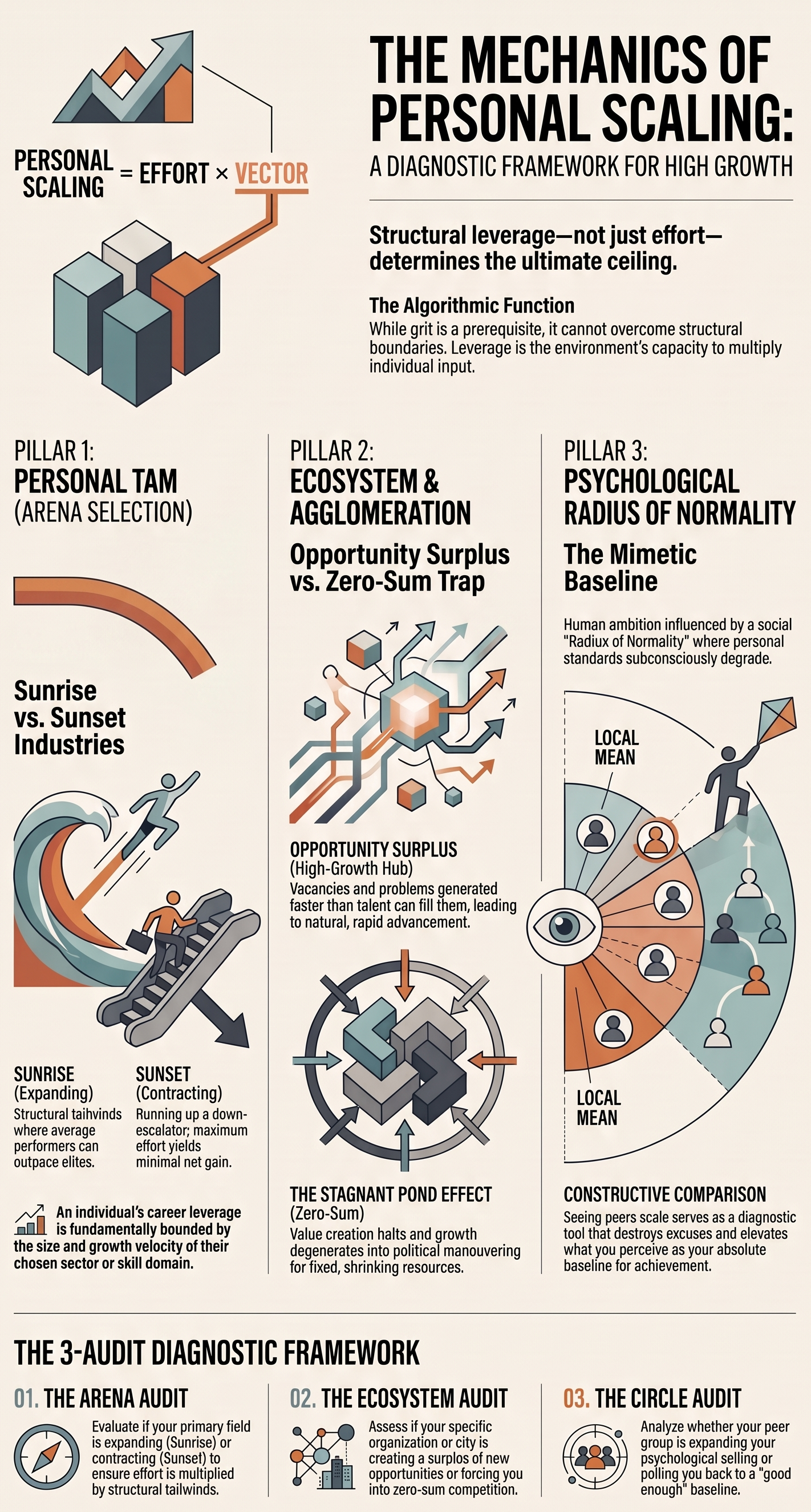
Just as a commercial product cannot outgrow the total size of its market, an individual’s personal ceiling is fundamentally bounded by three core forces: the field they choose (Personal TAM), the growth rate of their ecosystem (Agglomeration Tailwinds), and the ambition of their social circle (Psychological Ceilings). To scale up in life, hard work must meet expanding arenas.
1. Personal TAM:
Arena Selection Beats Micro-Effort
In business strategy, a startup’s valuation is capped by its Total Addressable Market (TAM).
If you build a product for a tiny, static market, your growth will hit a brick wall regardless of how good the product is.
The exact same economic law applies to your career: your chosen field acts as your Personal TAM.
Working in a declining or stagnant sector—such as traditional cement or sugar industry-is like trying to run up a downward-moving escalator.
You have to burn extraordinary energy just to stay in the exact same place.
Conversely, operating in a booming sector—like AI, SaaS,Wealth-management or renewable energy—gives you powerful macro tailwinds.
In a high-growth market, rising customer demand creates a constant surplus of leadership vacancies, capital allocation, and unsolved problems.
As a result, average performers in sunrise industries routinely outpace brilliant individuals trapped in stagnant fields simply because the macro tide carries everyone upward.
Unless you occupy an irreplaceable niche, picking a field with a restricted TAM imposes a hard structural limit on how far you can scale.
2. The Tide Effect: Geographic and Organizational Agglomeration
Beyond your broad industry, your day-to-day trajectory depends heavily on your immediate environment—the specific city where you live and the organization where you work.
High-growth tech hubs—like Bengaluru, Hyderabad, or NCR—and fast-scaling companies operate under an opportunity surplus.
When an enterprise or region expands rapidly, the sheer volume of high-stakes problems expands faster than existing teams can handle.
This structural imbalance forces rapid delegation, forcing younger professionals into early responsibility and continuous skill acquisition. In these environments, you scale because the ecosystem actively pulls you upward.
In contrast, stagnant industrial towns or plateaued corporate environments suffer from zero-sum dynamics. When overall value creation halts, advancement is no longer created through expansion; it must be extracted at someone else’s expense.
Growth degenerates into office politics and manoeuvring for fixed slices of a shrinking pie.
In a stagnant ecosystem, even elite talent and extreme work ethics plateau. The most strategic response to a stagnant pond is rarely swimming harder—it is migrating to a larger body of water.
3. The Psychological Radius of Normality
While external markets set the structural boundaries of your growth, your immediate social circle sets your internal boundary: your Psychological Radius of Normality.
Human behaviour is deeply mimetic.
We subconsciously calibrate our definitions of “hard work,” “success,” and “risk” against the baseline of the people around us.
If your primary circle is satisfied with routine comfort, short-term wins, or “good-enough” outcomes, your internal standards gradually degrade to match the local mean.
However, being embedded in an ambitious environment fundamentally alters your threshold for what is possible.
When your peers routinely launch global products, take calculated entrepreneurial risks, or push past comfort zones, extraordinary achievements cease to feel intimidating—they become the default baseline.
Scaling up requires surrounding yourself with people whose normal daily execution forces you to elevate your own ceiling.
4. Reframing Envy: Comparison as a Compass
We are often taught that social comparison is a toxic emotion. But when channelled constructively, aspirational comparison acts as a vital diagnostic tool.
Resentful envy stems from insecurity—the toxic urge to pull others down to your level.
Constructive comparison, by contrast, serves as a proof-of-concept.
Seeing a colleague or peer scale up shatters the comforting illusion that your current output represents your absolute ceiling.
It reveals what is achievable in your domain and exposes the precise gap between your reality and your latent potential.
When used intentionally, healthy comparison destroys passive complacency and converts vague desire into active momentum.
5. The 3-Audit Framework for Personal Scaling
To translate these principles into practical action, anyone seeking to scale up can conduct a systematic 3-Audit of their life:
1. The Arena Audit (Field & TAM): Is your primary domain expanding, static, or shrinking? Are you relying entirely on your own micro-effort, or is your field generating structural tailwinds that accelerate your momentum?
2. The Ecosystem Audit (City & Organization): Is your immediate environment generating an opportunity surplus, or are you competing in a zero-sum game for stagnant resources?
3. The Circle Audit (Psychological Baseline): Are the people closest to you expanding your definition of what is possible, or encouraging you to settle for “good enough”?
Conclusion: Aligning Effort with Vectors
Scaling up is not a simple linear function of working harder—it is an algorithmic function of Effort × Vector.
If your vector points into a shrinking market, a stagnant organization, or a complacent social circle, even extraordinary effort yields diminishing returns. But when high personal effort is aligned with a high-TAM field, an expanding ecosystem, and an ambitious community, growth becomes exponential. The ultimate key to scaling up is not just pushing harder, but positioning yourself in an arena that allows your effort to multiply.
If you wanna read something more on success-factors, you can read this article 5 Elements of Success.
14 claps



“Excellent write-up, Sir. Very insightful and thought-provoking. Truly inspiring..!!
🙏🏻🙏🏻
Very apt and beautifully written.