


Early Identification of Fast Growth Companies
Finding a great place to build your career isn’t just about applying to companies that are already household names or are already at their absolute peak.
Often, the best career growth, fastest promotions, and most exciting projects happen when you join a company right as it turns the corner from a stagnant phase into a massive comeback.
When a company is on the brink of a major operational turnaround, the internal culture shifts overnight—from defensive cost-cutting and red tape to rapid execution and expansion.
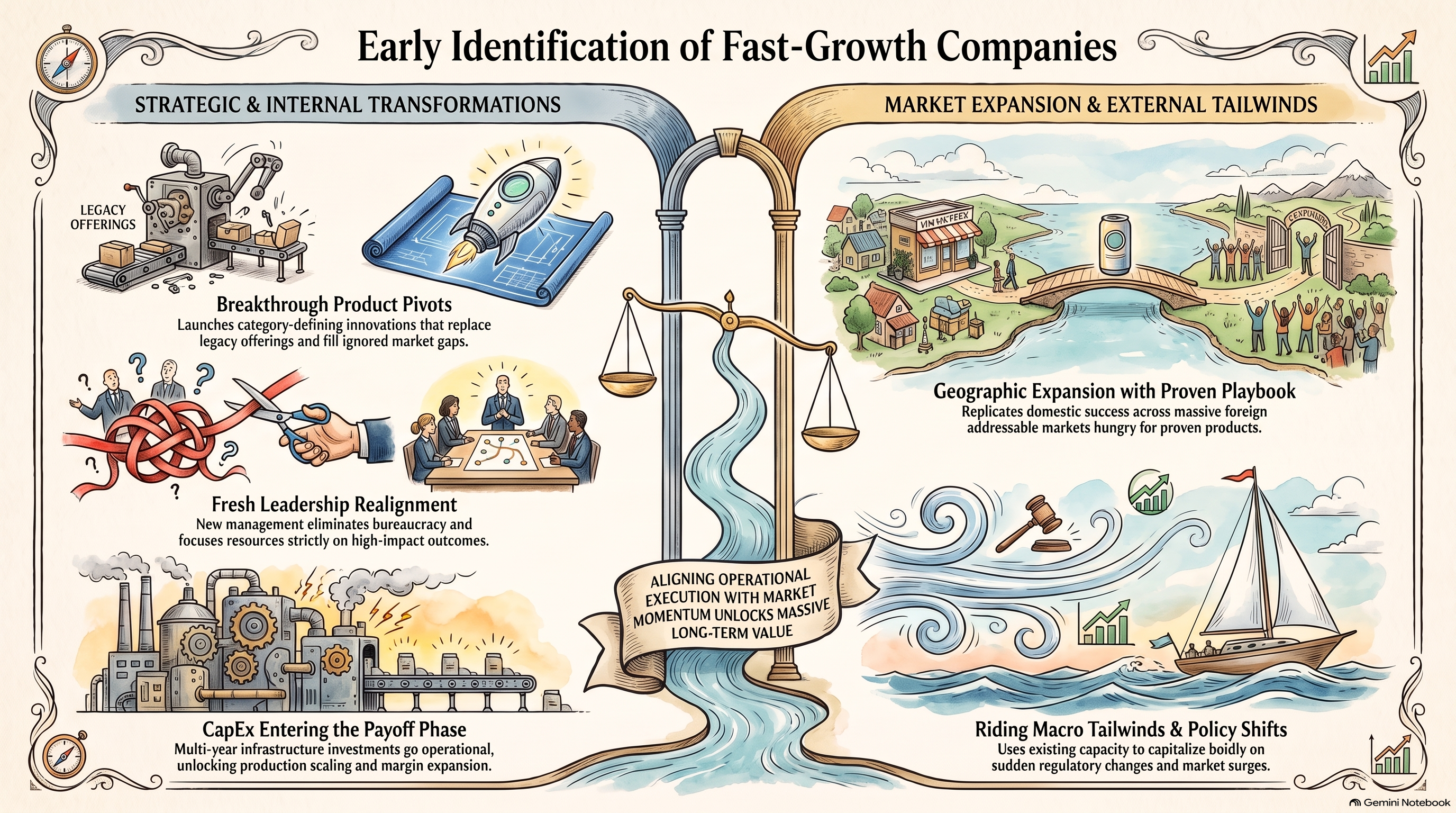
If you are looking for an exciting company to join or want to evaluate where your current employer is headed, here are 5 clear signals that a business is getting ready to roar back to life.
-
Launching Products That Actually Solve Unaddressed Needs
Real turnarounds rarely happen through minor product tweaks or cosmetic refreshes.
They happen when a company launches something genuinely superior to the competition or fills a glaring gap in the market that everyone else ignored.
When a business introduces a breakthrough product, its internal focus flips completely.
Instead of fighting over shrinking margins for legacy offerings, teams get mobilized around building, scaling, and supporting a new category.
Apple didn’t turn around in the early 2000s by simply making slightly faster desktop computers; it completely redefined consumer electronics with the iPod and iPhone.
Early Electric Vehicle (EV) pioneers didn’t try to incrementally improve internal combustion engines—they built software-first electric powertrains from the ground up, tapping into massive unmet demand for clean, tech-forward driving.
For employees, a product-led pivot means you are working on something people actually want, where engineering and creative efforts translate directly into market energy.
-
Expanding into Huge New Geographies with a Proven Playbook
Expanding into new geographies can be a risky gamble, but when done right, it multiplies a company’s potential overnight.
The trick is looking for two specific ingredients:
- The company already has a dominant, rock-solid track record in its home market.
- The new territory offers a massive Total Addressable Market (TAM) , that is hungry for those exact products.
- BYD perfected its low-cost, vertically integrated EV manufacturing and blade battery technology in China before making aggressive moves into Europe, Latin America, and Southeast Asia.
- Apple turned its domestic US success into a global powerhouse by scaling its retail and device ecosystem across Europe, Asia, and emerging economies.
When a company successfully cracks new or foreign markets, it creates a wave of internal opportunities—international transfers, new regional offices, and rapid career progression for people willing to lead new initiatives.
-
Riding Policy Shifts and Macro Tailwinds with Real Audacity
Sometimes external events give a business a massive, unexpected push.
Government policies change, federal budgets get reallocated, or a sudden narrative shift—like green energy or artificial intelligence—creates an explosion in demand.
However, a favourable tailwind only helps if the company already has spare capacity and a leadership team bold enough to seize the moment.
- In India, the government’s massive budget increases for railways and defence indigenization transformed quiet, legacy industrial firms into fast-growing execution machines virtually overnight.
- The sudden rise of Generative AI created an immediate crisis-level demand for high-performance chips and power grid infrastructure. Companies like Nvidia and power-equipment suppliers that had already built out specialized infrastructure were positioned to capture that wave immediately.
Working at a company that hits a macro tailwind feels like running with the wind at your back.
Projects get approved faster, budgets open up, and hard work yields visible, high-impact results.
-
Fresh Leadership Breaking Out of Old Mindsets
When a mature company gets stuck in its ways, it often takes a complete management reset to turn things around.
Legacy leaders tend to defend yesterday’s cash cows; new leaders arrive without emotional attachment to past decisions and are willing to challenge dogmas, cut non-core distractions, and try out-of-the-box ideas.
- Satya Nadella at Microsoft: Replaced the rigid “Windows-first” culture with an open, cloud-first focus on Azure and Office 365, turning a plateaued tech giant into a cloud and AI behemoth.
- Dr. Lisa Su at AMD: Took over a struggling chipmaker near bankruptcy and made a high-stakes bet to focus engineering purely on high-performance x86 computing architecture (Zen), eventually taking massive server market share from Intel.
- Siddhartha Lal at Eicher Motors: Inherited a bloated conglomerate operating 15 disparate businesses, shut down or sold 13 of them, and poured all capital into building Royal Enfield into a global mid-sized motorcycle icon.
- Sudhir Singh at Coforge: Shifted a generalist IT firm toward aggressive vertical specialization in insurance, travel, and banking, supercharging its growth and deal size.
A new, forward-thinking management team cleans out bureaucracy, simplifies structure, and rewards employees who drive real outcomes rather than those who just navigate corporate politics.
-
The Payoff Phase of Heavy Past Investments (Capex Completion)
Building factories, expanding data centres, or spending years in research and development is gruelling work.
While the investments are underway, a company’s financial statements look tight, budgets are restrained, and morale can feel tested.
The turnaround moment happens when those multi-year capital expenditures (Capex) are finally completed just as market demand kicks in.
Suddenly, the company can ramp up production without needing heavy new spending, creating a period of rapid operational scaling.
- TSMC spent tens of billions of dollars constructing advanced sub-7nm semiconductor fabrication facilities long before the current AI boom fully materialized. When the demand surge hit, TSMC stood as one of the few foundries on Earth with the active capacity to manufacture those advanced chips at scale.
- Laurus Labs spent years funding massive manufacturing capacity expansions for active pharmaceutical ingredients (APIs) and finished formulations. When those facilities went operational and achieved high capacity utilization, revenue and operating margins expanded sharply.
When a company transitions from “investing heavily” to “running at full capacity,” the workplace mood improves significantly.
Operating leverage kicks in, project deadlines shift from construction to delivery, and team accomplishments become front-page company wins.
Spotting Your Next Career Move
If you are evaluating your current workplace or looking at a prospective employer, don’t just look at last year’s revenue numbers. Look for these underlying structural shifts:
- Is there a fresh, ambitious product launch on the horizon?
- Is the company taking a proven model into massive new regions?
- Are macro policy winds pushing the business forward?
- Has new leadership come in to strip away legacy red tape?
- Are massive, long-term capital investments finally going live?
A company showing even two or three of these catalysts is usually far more than just a stable employer—it’s an organization on the verge of an exciting growth phase where your career can accelerate right along with it.
If you want more insights wrt career , you can read here .
5 claps